
Search and find – exhibitor search provides a comprehensive overview of industry players, featuring detailed profiles of the PCIM Expo exhibitors 2026 as well as the latest solutions and products in power electronics.
Liquid Cooling plates
Description
Gleemax offers super quality embedded tube cooling plates and FSW cooling plates and we supply Liquid Cooling solutions to our valued customers. In the fields of power electronic control, conversion, drive, signal transmission, and new energy (such as thermal management for new energy vehicle power batteries, UPS and energy storage system cooling, large server cooling, large photovoltaic inverter cooling, SVG/SVC cooling, etc.), when pursuing high efficiency, low noise, and low-temperature operation under space constraints, heat dissipation becomes the greatest limitation in product development. Liquid cooling technology has become the preferred thermal management solution. GLEEMAX's thermal design and management engineers possess extensive experience in the development of liquid cooling systems and liquid cooling plate manufacturing. We provide comprehensive liquid cooling solutions, offering free thermal design, structural design, water channel connections, and turnkey services for liquid cooling plate/water cooling plate systems.
Embedded Tube Cooling Plates
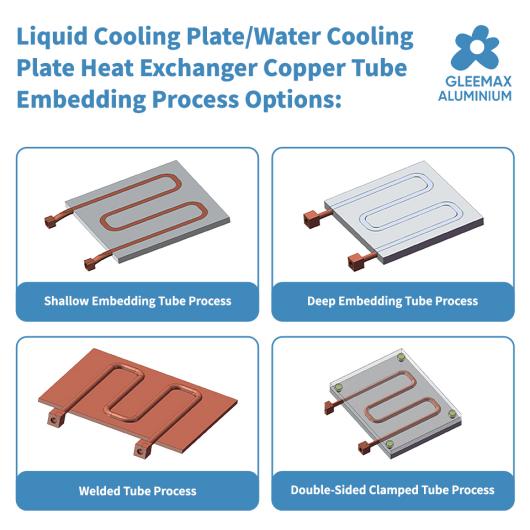
Liquid Cooling Plate/Water Cooling Plate Heat Exchanger Copper Tube Embedding Process Options are four, Shallow Embedding Tube Process,Deep Embedding Tube Process,Welded Tube Process and Double-Sided Clamped Tube Process.
Core Advantages of FSW Liquid Cooling Plates
Top-Tier Thermal Performance
Zero contact thermal resistance: Once heat is conducted from the heat-generating component to the substrate surface, it is immediately carried away by the coolant flowing through the channels. Unlike embedded-tube designs, heat does not need to bypass physical interfaces between tubes and the base plate.
Enhanced heat transfer with internal fins: Designers can incorporate a large number of fins inside the flow channels, greatly increasing the contact area between the coolant and the metal. At the same time, the fins promote turbulent flow, multiplying heat transfer efficiency.
Extremely High Reliability
High pressure resistance: The monolithic structure allows the plate to easily withstand pressures of 1.0–3.0 MPa or even higher, far exceeding the requirements of typical liquid-cooling systems.
Excellent thermal shock resistance: Under severe and rapid temperature cycling (such as sudden power changes during rapid acceleration or braking in electric vehicles), the integral structure avoids fatigue cracking and leakage caused by mismatched thermal expansion coefficients of different materials (e.g., copper tubes and aluminum base plates), ensuring long-term airtightness.
Excellent Temperature Uniformity
The flow channels can be designed to distribute cooling “on demand” to multiple heat sources, or arranged in parallel for large-area heat sources (such as battery packs), ensuring very small temperature differences across the entire surface and effectively preventing localized hot spots.