
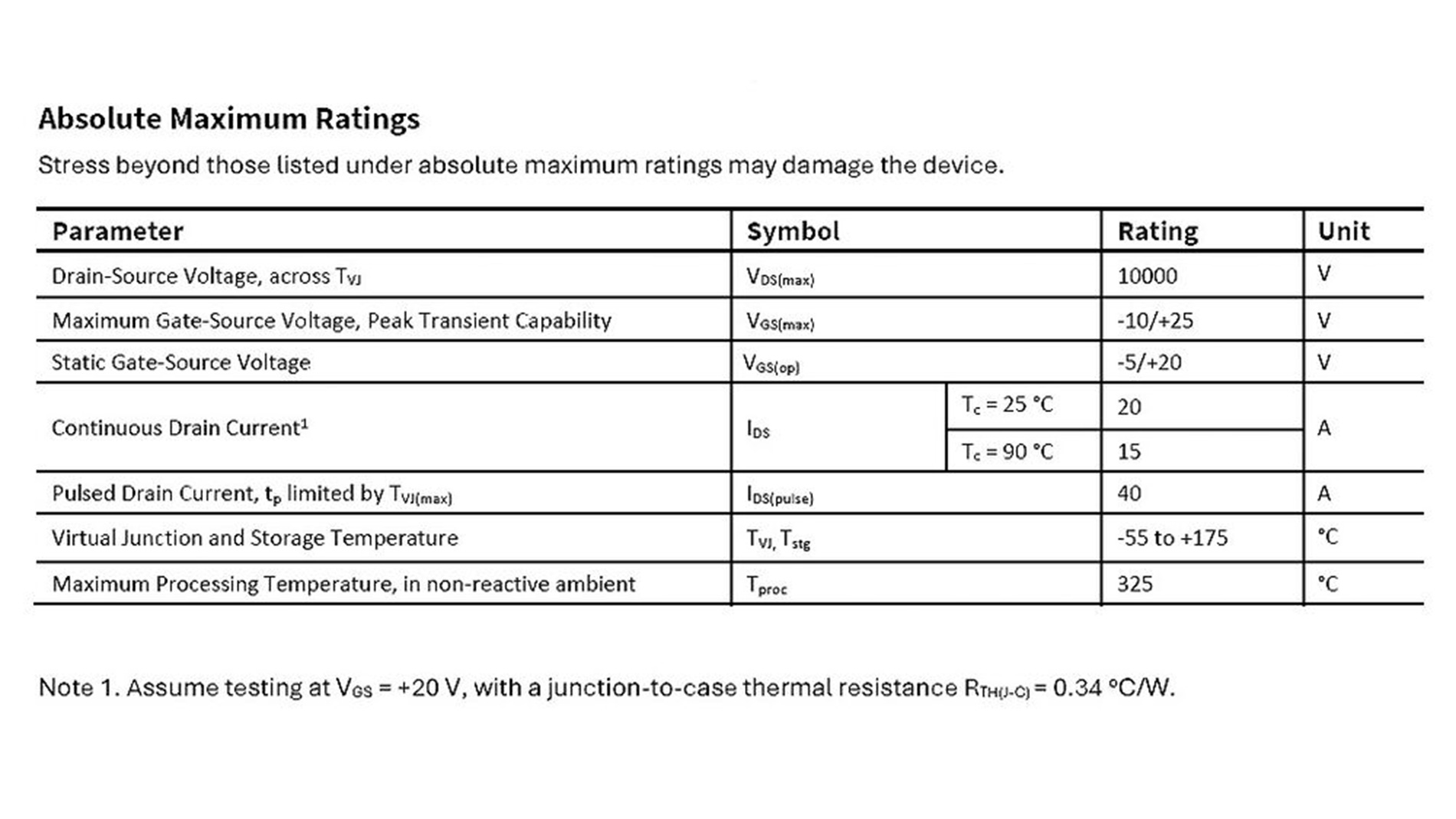
Wolfspeed’s device has a breakdown voltage of 10 kV and an on-resistance of 305 mΩ at a rated current of 20 A, and due to their unipolar operation, SiC MOSFETs enable significantly lower switching losses and higher switching speeds than IGBTs. They also possess an intrinsic parasitic body diode that can be utilised in reverse current operation. A well-known reliability issue with high-voltage-resistant SiC devices is bipolar degradation (BD). When current flows through the body diode, minority charge carriers are injected, causing existing crystal defects, particularly basal plane dislocations, to expand irreversibly. This increases the forward voltage of the diode and can compromise the device’s reliability. According to the manufacturer, a key technical feature of the presented MOSFET is its ability to control or prevent these degradation mechanisms, even when the body diode is in use. Wolfspeed’s TDDB (time-dependent dielectric breakdown) analyses indicate a theoretical lifetime of up to 158,000 years at a continuous gate bias voltage of 20 V.
Realizing Pulsed-Power Potential: Enabling Next-Generation Applications
With a rise time of less than 10 nanoseconds, the new technology can replace conventional mechanical spark-gap switches, which degrade over time due to high-current, high-temperature arcing. This increases maintenance costs and the total cost of ownership. The new technology uses SiC MOSFET-based solid-state switches. These solid-state devices eliminate arcing and enable efficient energy transfer and improved timing precision for pulsed power transfer. They also reduce size and system complexity for high-performance pulsed-power applications, including geothermal power generation, power generation for AI data centers, semiconductor plasma etching and sustainable fertiliser production.
Powering AI with reliable silicon carbide-based solid-state transformers
Ashish Kumar, Ph.D., MHV Research Scientist at Wolfspeed, describes an application for which the new silicon carbide (SiC) metal–oxide–semiconductor field-effect transistors (MOSFETs) are particularly well suited: AI Data centers. He mentions a major infrastructure challenge in the expansion of AI Data centers: the short supply of conventional medium-voltage transformers, with lead times of up to three years. Solid-state transformers (SSTs) are being discussed as an alternative. These power electronic systems can convert medium-voltage AC directly into the DC required by Data centers. Compared to traditional iron-core transformers, SSTs offer faster controllability, potentially more compact designs, and a modular architecture.
The grid connection for Data centers typically ranges from 13.8 to 35 kV AC. SSTs comprise several power electronic converter cells for this purpose. Multi-level architectures with devices connected in series are usually required when using SiC devices with breakdown voltages below 5 kV. Conversely, high-voltage-capable SiC devices above 5 kV enable simpler topologies with fewer cells.
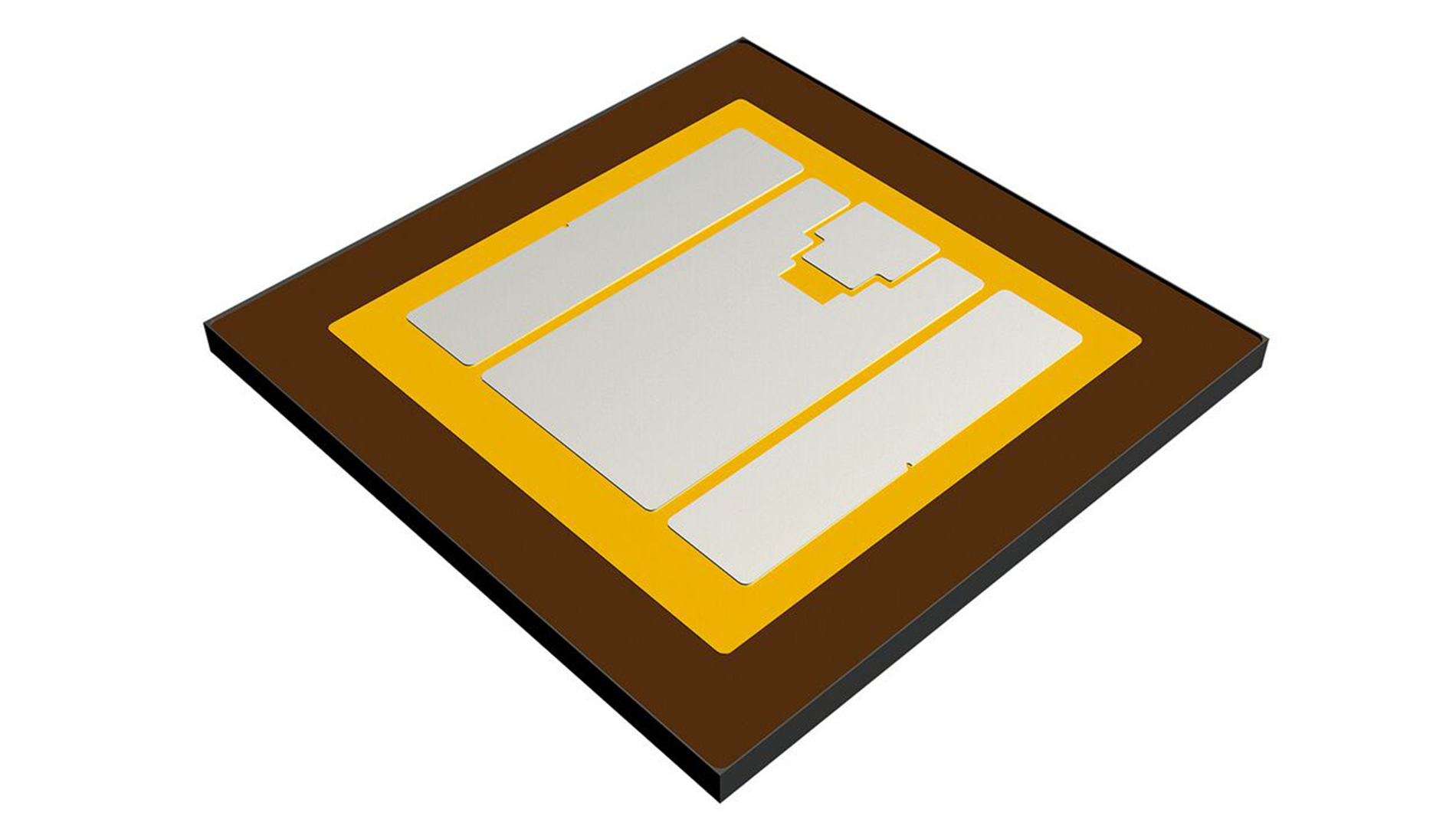
According to Wolfspeed, their 10 kV SiC MOSFET CPM3-10000-0300A is a key component for such high-voltage SSTs. For compact SSTs, switching frequencies above 10 kHz are important as they reduce the size and weight of magnetic components. However, high-voltage silicon IGBTs with typical reverse voltages of around 6.5 kV are usually only suitable for switching frequencies in the range of a few hundred hertz due to high switching losses.
High switching frequencies are crucial for SST applications because the required magnetic components, particularly coils and transformers, can be designed to be much smaller and lighter at higher frequencies. Typical target values are above 10 kHz. However, conventional high-voltage silicon IGBTs with reverse voltages in the range of 6.5 kV are generally only suitable for a few hundred hertz due to high switching losses, meaning they are not ideal for compact SST designs. SiC MOSFETs enable significantly lower switching losses and faster switching operations due to their unipolar structure.
Kumar once again refers to the reliability issue caused by the bipolar degradation of the intrinsic body diode and elaborates: ‘In our 10 kV SiC MOSFET, no bipolar degradation occurred during Body Diode Operating Life (BDOL) tests lasting over 1,000 hours.’
Sensitivity to cosmic radiation is another important reliability requirement in high-voltage operation, as high-energy particles can trigger single-event failures, particularly at high reverse voltages. According to Kumar, the device exceeds industry-standard requirements for the failure-in-time (FIT) rate by a factor of four during typical operation at 6,000 V DC.
Features and areas of application summarized
| Features | Typical Applications |
|---|---|
|
|
Summary of the benefits
- Reduce system cost by approximately 30%: Using 10 kV SiC allows designers to consolidate multi-cell designs into fewer cells and downsize three-level inverters to a two-level topology
- Improve power density by more than 300%: Increasing switching frequencies from 600 Hz to 10,000 Hz simplifies control and gate drive circuitry, while also shrinking magnetics
- Reduce system-level thermal requirements by up to 50 %: Achieving 99 % conversion efficiency enables better thermals than IGBTs.
- Wolfspeed was awarded with the first PCIM Top Innovation – let’s see who wins it next year! As an exhibitor of the PCIM you are welcome to simply submit innovative developments when the next call for entries is announced. st