SiC MOSFETs as an Enabler for the Next Generation of AI Data Centers
9 Jun 2026
The next evolutionary stage of artificial intelligence will not be limited by computing power—but by energy. As AI clusters push toward ever higher power densities, the central challenge is shifting from data processing to low-loss energy supply. This is precisely where a technological lever emerges that is often underestimated: the choice of power semiconductor.
By Ole Gerkensmeyer, Chief Strategy Officer, Nexperia
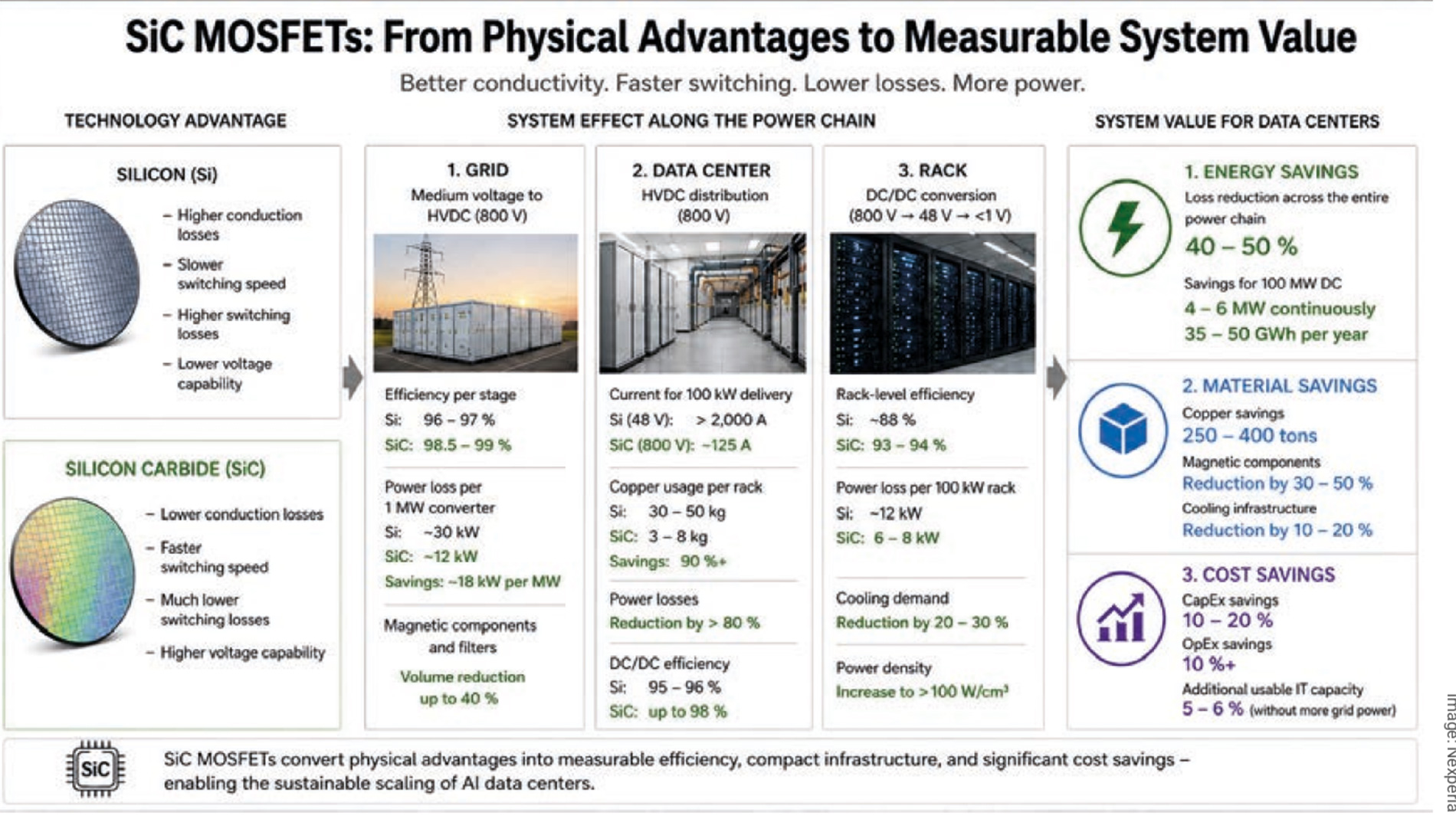
The use of SiC MOSFETs represents a fundamental break from traditional silicon architectures. The difference lies not only in incremental improvements, but in the physical properties themselves. Lower conduction losses and significantly higher switching speeds enable more efficient energy conversion, drastically reduce losses, and simultaneously shrink the overall infrastructure. What begins at the component level scales across the entire system—up to measurable megawatt-level effects.
Grid: Efficiency Begins at the Grid Connection
At the transition from the power grid to the data center, it is determined how much energy is actually usable. Conventional silicon solutions typically operate at efficiencies of 96 to 97 percent. In contrast, SiC-based systems achieve up to 98.5 to 99 percent. This difference of just a few percentage points may initially seem marginal, but it has a significant impact at megawatt-scale power levels.
In a 1 MW converter, losses drop from about 30 kW to around 12 kW. At the same time, the higher switching frequencies of SiC—up to 100 kHz—enable a drastic reduction in the size of transformers and filters. Fewer losses mean less cooling, less volume, and ultimately lower system costs.
Data Center: High Voltage Replaces Copper
The real revolution becomes evident in power distribution within the data center. While conventional 48 V architectures require currents exceeding 2000 A for 100 kW loads, an 800 V system reduces the current to approximately 125 A. This physical shift has immediate consequences: copper demand decreases by more than 90 percent. Instead of 30 to 50 kg per rack, only 3 to 8 kg are needed. In a hyperscale data center, this adds up to savings of 250 to 400 tons of copper. At the same time, conduction losses decrease by more than 80 percent. This is enabled not only by the higher voltage, but also by the efficiency and switching speed of SiC, which allows for compact and low-loss DC/DC converters with efficiencies of up to 98 percent. The result is a significantly leaner, more efficient, and more scalable power infrastructure.
“A conventional 48 V System require currents exceeding 2000 A for 100 kW loads. An 800 V System reduces that current to approximately 125 A. The copper demand decreases by more than 90 percent. Instead of 30 to 50 kg per rack, only 3 to 8 kg are needed.”
Rack: Less Heat, More Computing Power
At the rack level, these effects directly impact the reality of modern AI systems. Accelerator chips generate extreme load transients and require highly dynamic power delivery. This is where SiC demonstrates its second major strength: fast switching.
Lower switching losses and higher frequencies improve power supply efficiency from around 88 percent to as much as 93–94 percent. For a 100 kW rack, this means a reduction in power loss from approximately 12 kW to 6 to 8 kW.
This difference is not just numerical—it is physically tangible: less heat dissipation, reduced cooling requirements (−20 to 30 percent), and more compact designs. At the same time, additional electrical power becomes available, which can be directly converted into computing capacity.
System: The Megawatt Effect
Across the entire energy chain, losses are nearly halved—from about 12–13 percent in conventional silicon systems to 6–8 percent with SiC.
For a data center with 100 MW of grid connection capacity, this translates into savings of 4 to 6 MW of continuous power—or 35 to 50 GWh per year. More importantly, it is not just the savings themselves that matter, but their impact: this energy becomes immediately available as additional IT power.
In practice, this corresponds to approximately 5 to 6 percent more usable computing capacity—or around 60 additional high-performance racks, without increasing the grid connection capacity.
At the same time, material usage drops dramatically: several hundred tons less copper, up to 50 percent fewer magnetic components, and significantly reduced cooling structures. These effects translate directly into lower capital expenditures and operating costs. Both CapEx and OpEx can be reduced by double-digit percentages.
Conclusion: From Component to System Advantage
The advantages of SiC—better conductivity and faster switching speed—are not isolated characteristics. They propagate along the entire energy chain and transform electrical efficiency into real system benefits: fewer losses, less material, and lower costs.
For operators of AI data centers, this represents a paradigm shift. Growth is no longer limited solely by energy availability, but increasingly by the efficiency of the deployed technology. At Nexperia, we therefore view SiC not as an option, but as a prerequisite for the next generation of scalable, cost-efficient, and sustainable data centers. eg