By Dr. Maximilian Hofmann, Liu Xinjun, Dr Bernd Eckardt, all at Fraunhofer IISB
Recent market studies estimate the global humanoid robotics market at approximately USD 7.8 billion in 2025 and forecast growth to well above USD 200 billion within the next decade, corresponding to annual growth rates of around 35-40%. At the same time, major technology companies and robotics start-ups are investing billions of dollars into humanoid and highly mobile robotic platforms intended for manufacturing, logistics, healthcare and service applications. (I, II) While public attention is largely focused on artificial intelligence, the physical performance of future robotic systems will ultimately be determined by their hardware platform. Mobility, payload, operating time, efficiency and cost are fundamentally constrained by electric actuators, power electronics, energy storage systems and charging infrastructure. From a power electronics perspective, humanoid and quadruped robots represent an interesting emerging application domain. A single robotic platform may incorporate dozens of distributed electric actuators and local inverter stages combined with battery-based energy storage systems, AI processors and sensor networks.
System Architecture: The Case for a 48-V DC Backbone
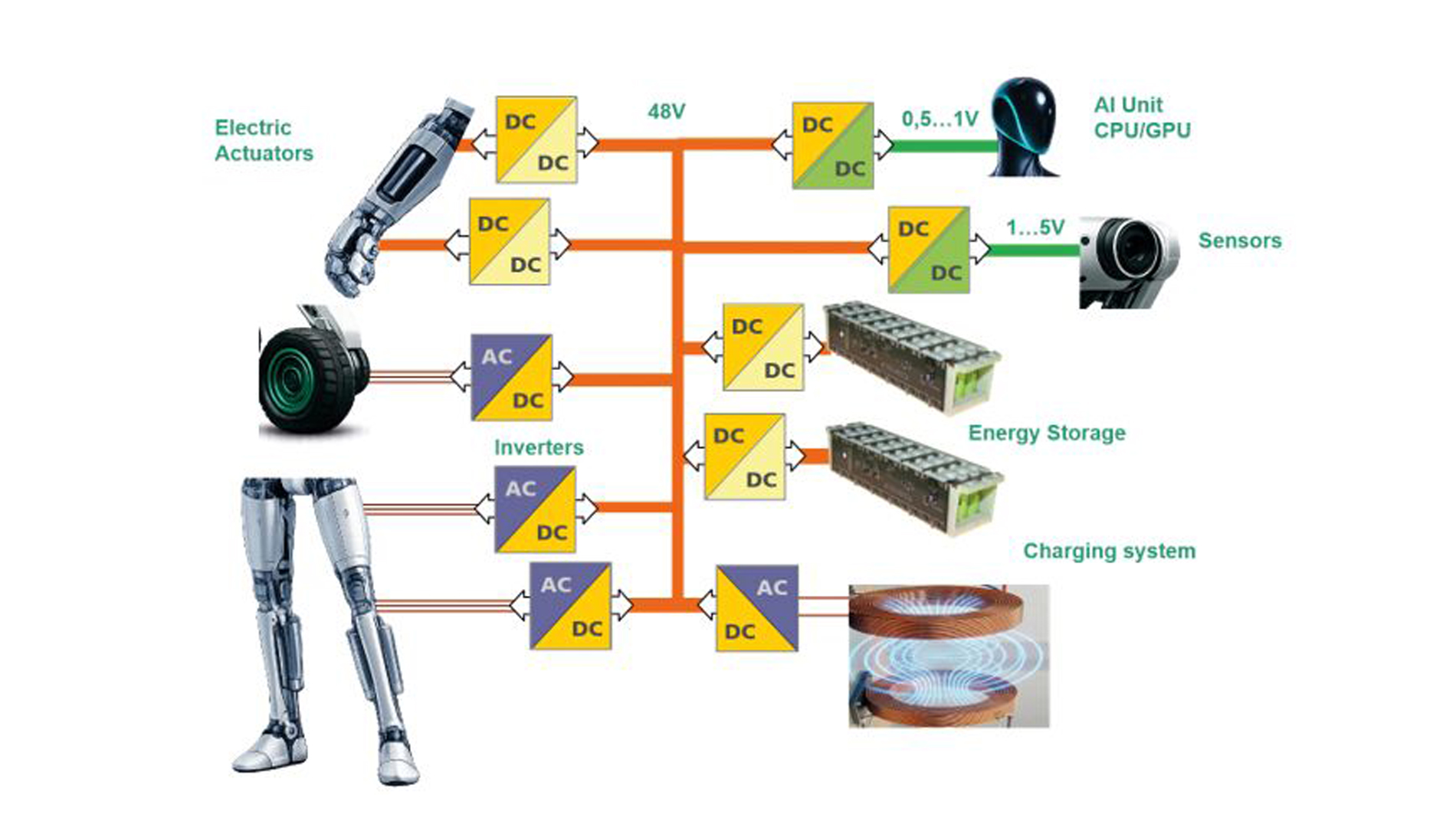
Future humanoid and legged robots can be regarded as highly distributed electrical energy systems comprising multiple actuators, embedded computing hardware, sensor networks and energy storage systems. A promising architecture for such systems is based on a common 48-V DC backbone supplying decentralized power conversion stages for actuation, sensing and data processing. A conceptual design of such an architecture is shown in Figure 1.
While no universally accepted voltage level for future robots has yet emerged, 48 V represents an attractive compromise between efficiency, safety and system complexity. Compared to low-voltage architectures below 24 V, conductor currents can be reduced significantly, lowering cable losses, connector stresses and wiring mass. At the same time, 48-V systems avoid many of the insulation, safety and EMC challenges associated with high-voltage architectures. For example, supplying a 3 kW joint actuator requires approximately 125 A at 24 V, but only 62.5 A at 48 V. The resulting reduction in conduction losses and cable cross-section strongly motivates the use of a 48-V architecture.
The distributed nature of humanoid robots strongly favors local power conversion. Instead of a centralized inverter supplying multiple motors, each robotic joint can be equipped with a dedicated three-phase inverter located directly adjacent to the electric machine. Such an approach minimizes motor cable lengths, reduces electromagnetic emissions and enables highly modular actuator designs. Furthermore, local inverters allow individual control of torque, speed and regenerative operation at each degree of freedom. The architecture shown in Figure 1 therefore combines distributed actuator inverters with centralized energy storage connected through the common DC bus.
An important feature of this architecture is the coexistence of multiple voltage domains. Whereas electric actuators operate directly from the 48-V distribution level, sensors typically require supply voltages between 1 V and 5 V and AI accelerators or GPU-based computing units may operate at core voltages below 1 V. Consequently, several local DC/DC conversion stages are required to generate application-specific supply rails.
High-Power-Density Actuator Concepts for Future Robotic Systems
Unlike conventional industrial drive systems, robotic actuators increasingly follow a highly integrated design philosophy. Electric machine, power electronics, sensing, mechanical transmission and thermal management are combined within a single compact mechatronic module. Such integration reduces inactive mass, minimizes cable lengths and parasitic inductances, lowers electromagnetic interference, and enables a holistic optimization of the complete energy conversion chain. Rather than optimizing motor, inverter and mechanics independently, future robotic actuators are developed using an electric, electromagnetic, thermal and mechanical co-design approach.
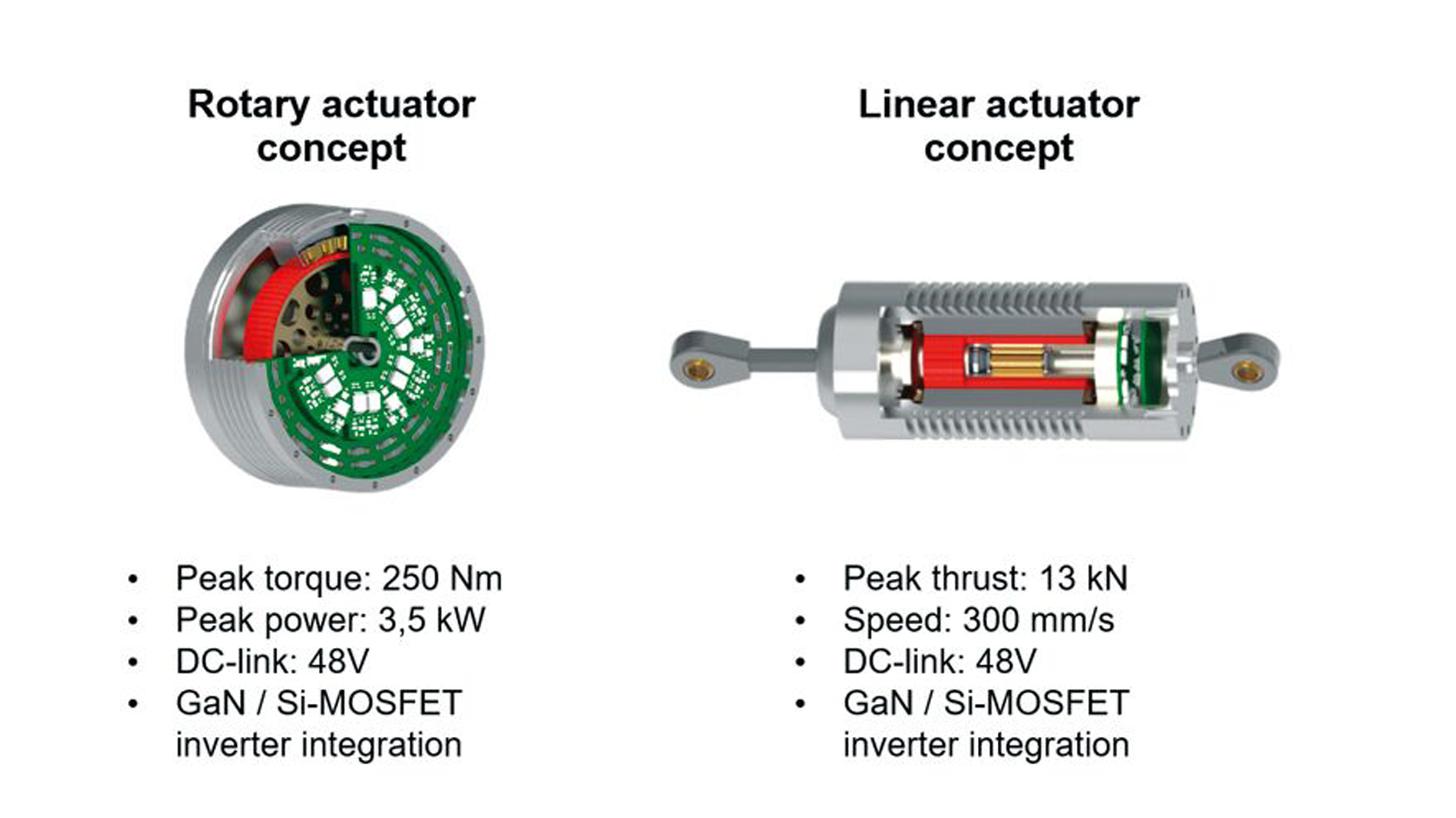
The actuator concepts of Fraunhofer IISB shown in Figure 2 illustrate two complementary approaches for future robotic systems: a highly integrated rotary joint actuator and a compact high-force linear actuator.
Rotary Joint Actuator
The rotary actuator is designed as a compact robotic joint drive with frameless electric machine for applications such as shoulder, elbow, hip or knee joints. Operating from a 48 V DC architecture, the current demonstrator delivers up to 250 Nm peak torque and 3.5 kW peak power for 10 s, while providing 30 Nm rated torque and 0.4 kW continuous power at a transmission ratio of 22. The resulting peak-to-rated power ratio highlights the strongly dynamic operating conditions encountered in robotic systems.
A key element of the concept is the electric machine design. The motor employs concentrated rectangular windings with short end-winding sections, improving copper utilization and reducing resistive losses compared to conventional distributed winding topologies. In addition, the rotor features a Halbach-array design without heavy rare-earth materials, which reduces torque ripple and cogging torque and thus enables smoother output performance. PCB-based phase interconnections further reduce electrical resistance and parasitic inductance while supporting a compact and reproducible assembly process. The inverter is integrated directly into actuator and can employ GaN or Si-MOSFET devices depending on the operating requirements. GaN devices, however, offer significant advantages when power density and integration become the primary design objectives. Compared to silicon MOSFETs, GaN transistors exhibit substantially lower gate charge and output capacitance, enabling switching frequencies above 100 kHz. Increasing the switching frequency from typical silicon values of 20–50 kHz to more than 100 kHz reduces motor current ripple, allows significant reductions in DC-link capacitance and magnetic component volume, and reduces additional losses in the motor system. Since passive components frequently occupy more space than the semiconductor devices themselves, this directly increases volumetric power density at actuator level.
The current actuator therefore serves not only as a compact high-performance joint drive, but also as a technological platform for future quasi-direct and direct-drive robotic actuators with reduced dependence on mechanical transmission.
Linear Force Actuator
While rotary actuators dominate many robotic joints, linear actuators become attractive whenever compact force generation and short mechanical load paths are required. The presented actuator integrates a high-speed electric motor with an inverted planetary roller screw into a compact coaxial architecture capable of delivering up to 13 kN dynamic thrust at linear velocities of 300 mm/s. The complete actuator occupies a diameter of only 70 mm and a total length of 285 mm.
The use of an inverted planetary roller screw enables efficient conversion of rotary into linear motion while maintaining high load capability and stiffness. Compared with conventional ball-screw systems, the concept provides a more compact force path and improved suitability for highly loaded robotic joints operating under dynamic conditions. These characteristics make the actuator particularly attractive for humanoid leg applications, where compactness, robustness and high axial force capability are critical.
Beyond its current implementation, the concept provides a development platform for future robotic force actuators in which mechanical conversion stages can be progressively reduced and force generation can move closer to the electromagnetic actuator itself.
Inductive Charging as an Enabler for Robotic Infrastructure
The energy supply infrastructure will play a decisive role in the large-scale deployment of humanoid and mobile robotic systems. While significant attention is currently devoted to actuator technology and artificial intelligence, operational availability is ultimately determined by how energy is replenished during operation. Conventional conductive charging systems are mature and highly efficient, but introduce contact wear, contamination risks and positioning requirements that become increasingly challenging in fully autonomous environments. Battery-swapping concepts can reduce charging downtime but require complex mechanics, additional battery inventory and a high degree of standardization.
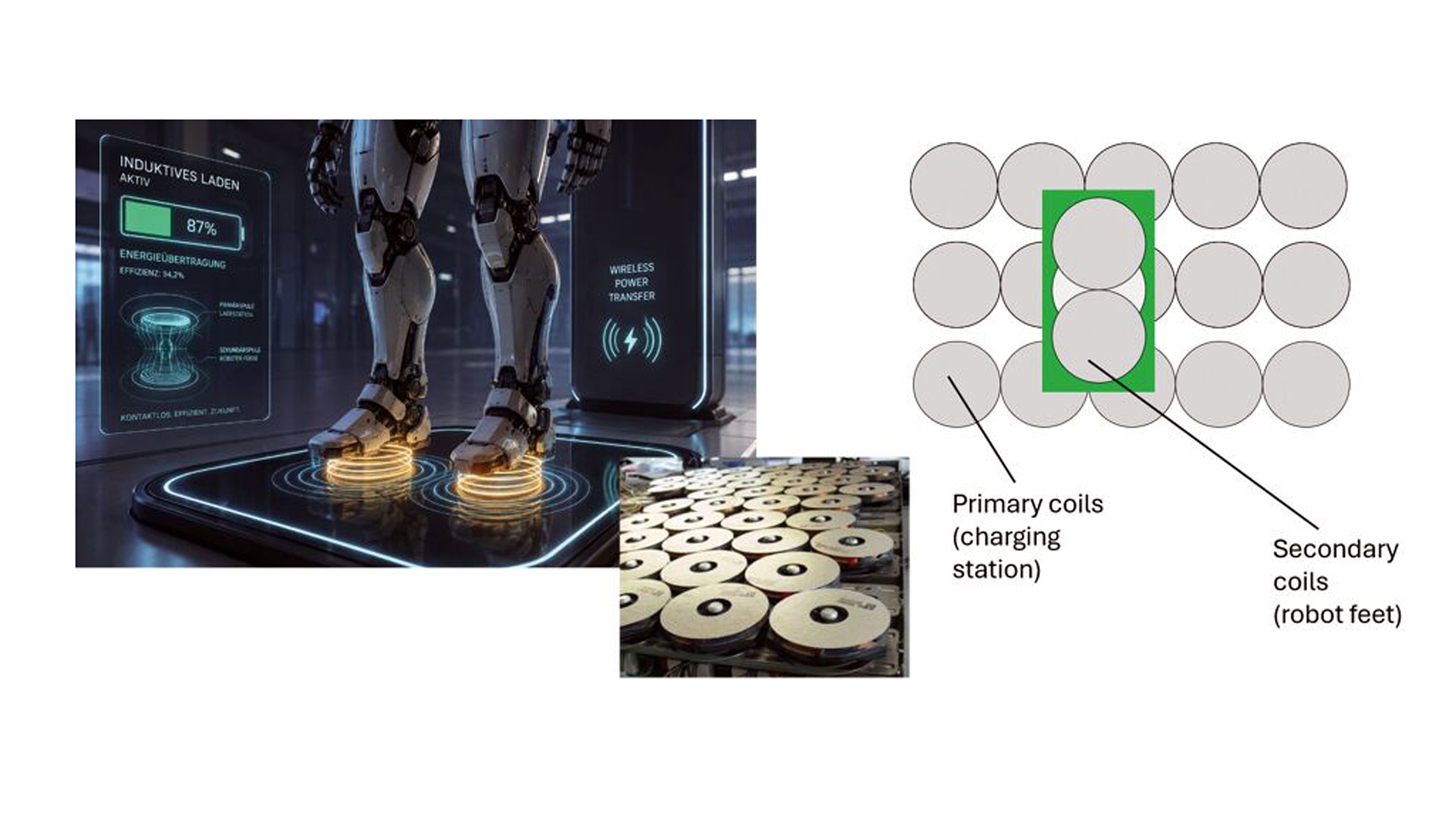
Inductive power transfer (IPT) offers an attractive alternative. The technology combines contactless operation with high flexibility, robustness and interoperability between different robotic platforms. In contrast to charging stations with exposed electrical contacts, wireless charging enables fully automated energy replenishment without mechanical wear and can be seamlessly integrated into the robot itself. The concepts investigated by Fraunhofer IISB target charging powers from 200 W up to 7.2 kW per foot of a robot with DC-to-DC efficiencies of up to 97 %, making wireless power transfer a viable option even for highly mobile robotic systems.
The envisioned application scenario is illustrated in the conceptual depiction of a humanoid robot charging through coils integrated into its feet in figure 3. The receiver coils are embedded directly into the robotic structure and transfer energy from floor-integrated primary coils without requiring dedicated charging connectors. This approach not only simplifies autonomous operation but also enables highly position-tolerant charging processes suitable for real production and logistics environments.
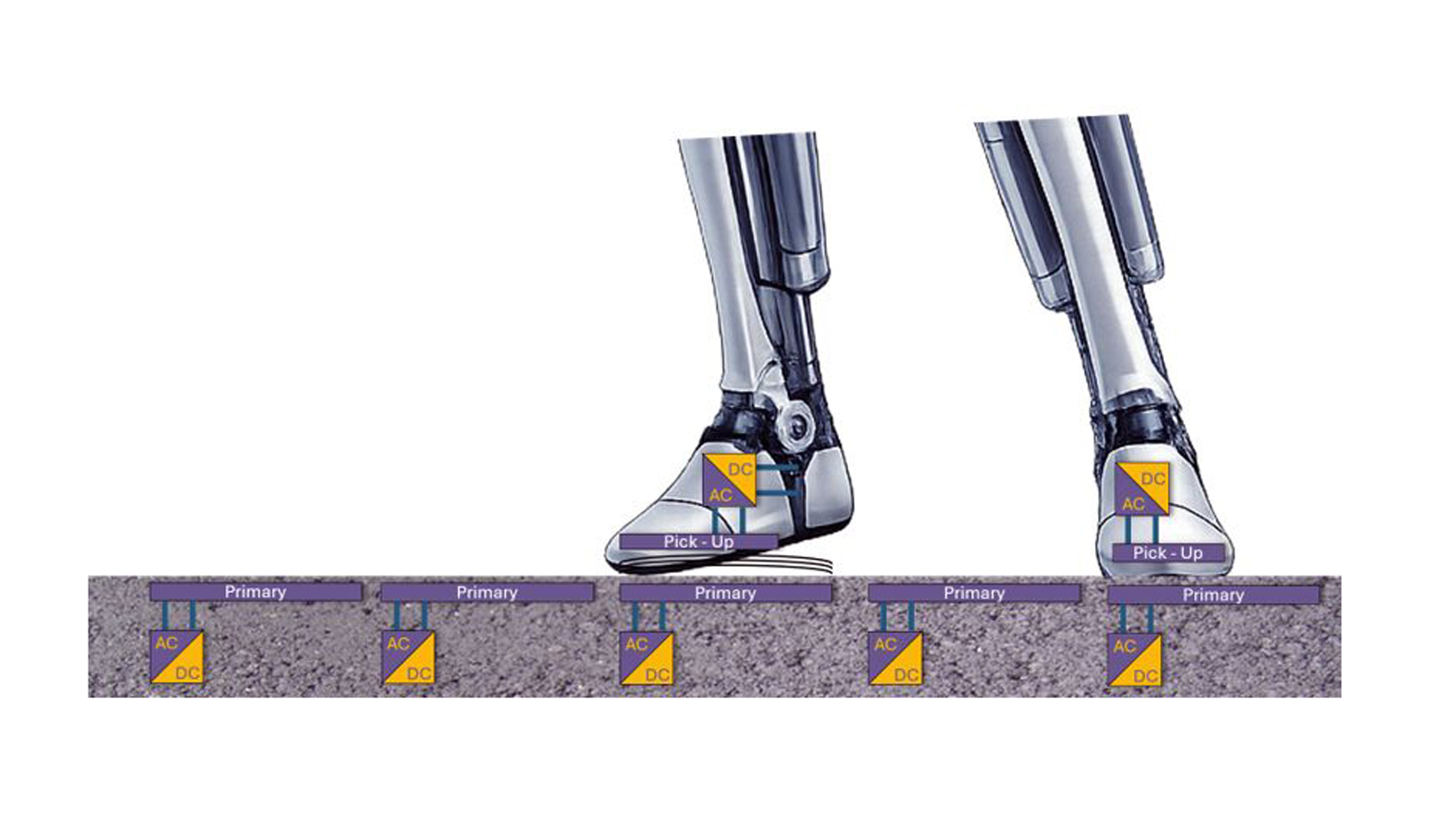
The underlying charging concept is based on a modular receiver architecture integrated into the robot feet. A single receiver with 12 cm diameter can transfer up to 3.6 kW, while the available charging power scales with the number of active receiver coils. Configurations with two and four coils provide charging powers of approximately 7.2 kW and more than 14 kW, respectively, while maintaining high overall efficiency.
From a power-electronics perspective, maintaining high efficiency despite unavoidable air gaps and positioning tolerances represents the primary challenge. The achievable transfer efficiency is determined by the magnetic coupling coefficient k, the resonator quality factors Q1 and Q2, and the losses of the semiconductors. High-performance IPT systems therefore require simultaneous optimization of coil geometry, resonant compensation networks and converter topology.
To address this challenge, the charging infrastructure can be implemented as a segmented field of individually controllable primary coils embedded in the factory floor. Depending on the robot position, only the required coil segments are activated, enabling highly localized energy transfer while minimizing standby losses and stray magnetic fields. As the robot moves through the environment, the active charging zone effectively follows the robot by sequentially energizing neighboring coil segments.
This concept directly builds on the extensive activities of Fraunhofer IISB in the field of dynamic wireless power transfer. Within the E|Road Center, technologies for stationary and dynamic charging of electric vehicles are being developed and industrialized. The same principles can be transferred to robotic systems, allowing energy to be supplied not only while robots are stationary, but also while moving through production facilities or logistics environments.
Such an infrastructure fundamentally changes the system-level optimization of robotic platforms. Instead of periodically interrupting operation for charging, robots can continuously replenish energy while standing at workstations, waiting for tasks or moving along frequently used transportation routes. If part of the required energy is supplied dynamically by the environment, onboard battery capacity can be reduced, resulting in lower system mass, lower actuator loading and improved overall efficiency. Particularly for humanoid robots, where battery weight directly impacts locomotion energy demand and actuator sizing, infrastructure-supported charging may become a key enabling technology for future large-scale robotic deployment. st
References:
I: https://www.futuremarketinsights.com/reports/humanoid-robot-market
II: https://www.idtechex.com/en/research-report/humanoid-robots/1093
About Fraunhofer IISB
Fraunhofer IISB is one of Europe’s leading research institutes in power electronics, spanning the entire innovation chain from semiconductor technologies and power devices to electric drives, energy systems and application-oriented power-electronic solutions. The institute combines expertise in power semiconductor technologies, converter systems, electric machines, battery systems, wireless power transfer and reliability engineering within a single research environment.
In the field of robotics, Fraunhofer IISB focuses on the development of the physical components required for future highly mobile robotic systems like high-power-density actuator systems, integrated power electronics for robotic joints, low-voltage GaN- and Si-based converter technologies, wireless charging infrastructure and the electro-thermal-mechanical co-design of highly integrated mechatronic subsystems. st