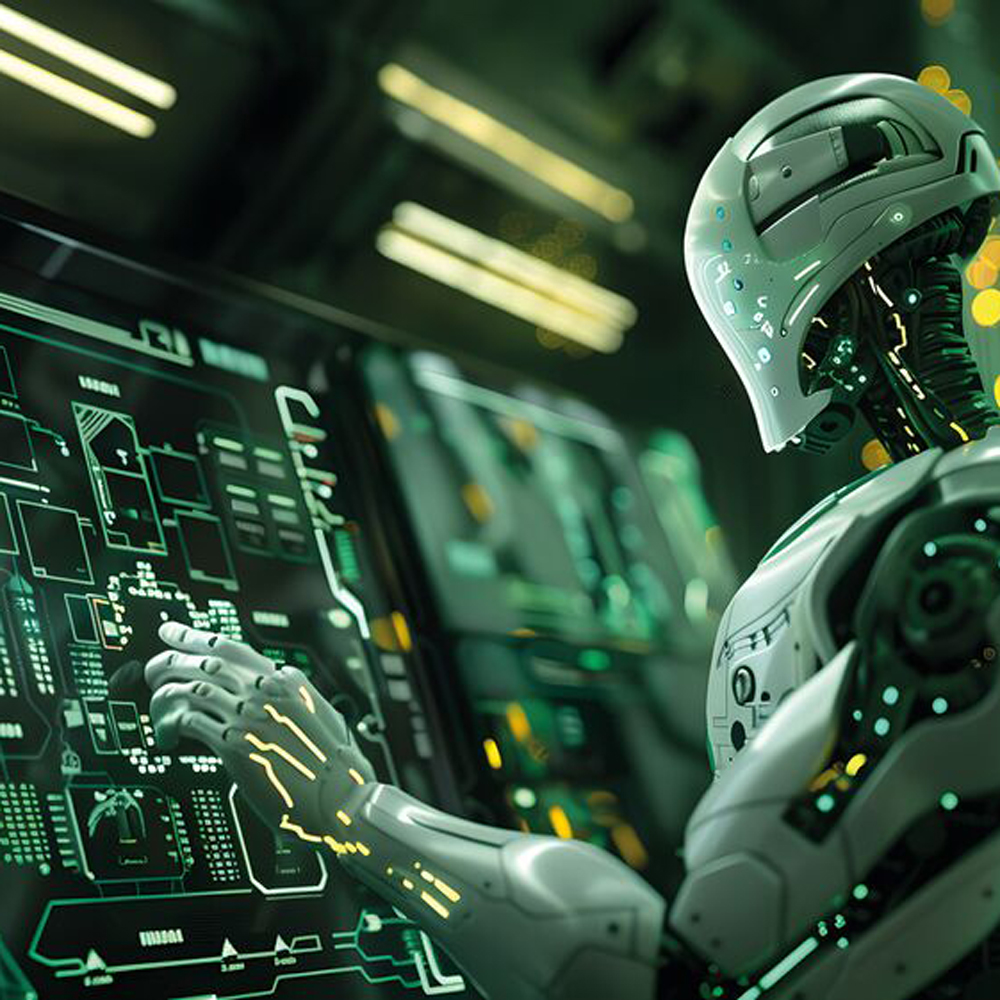
You are likely familiar with the Hollywood film “I, Robot.” In this movie, set in a not so distant Chicago in the year 2035, humanoid robots are ubiquitous artificial beings employed across many sectors of human life as workers and assistants. Where there are humans, there are also murders.
Detective Del Spooner haunted by recurring flashbacks of a traumatic experience involving humanoid robots is tasked with investigating a murder case in which humanoids also appear to be implicated. So goes this vision of the future, based on the novel “I, Robot” by Isaac Asimov.
In the reality projected by market researchers for the year 2035, it is estimated that approximately 2.1 million humanoid robots will be in use worldwide a relatively small number from today’s perspective. Current projections suggest that in developed nations, many people would be willing to purchase such a humanoid designed to assist with daily tasks if it were priced at around 25,000 dollars/euros. From the perspective of the electronics and semiconductor industry, a future with humanoid robots is, first and foremost, a multi-billion-dollar business.
For “physical AI” to operate in the human world independently of the cloud, it requires not only powerful central processing units but, crucially, sensory components, power semiconductors, and specialized control Ics all of which are essential for ensuring the mobility of a humanoid.
Semiconductor manufacturers currently estimate that, depending on the chosen architecture, each humanoid platform will incorporate between 500 and 600 dollars’ worth of semiconductor components.
While efforts are currently underway primarily in the United States and China to develop humanoid robots that are as high-performing as possible and designed to resemble humans, the medium- to long-term future will inevitably raise questions about how social interaction between humans and humanoids will take shape. It is no surprise that the prophets of the AI and robotics age paint these new possibilities in the most glowing terms. Yet, as seen recently in the lead-up to the U.S. midterm elections, the initially positive attitude Americans held toward AI data centers appears to be shifting. It remains to be seen how this will play out in the case of humanoid robots though, fortunately, things need not necessarily take a turn for the worst, as they did in *I, Robot*. eg