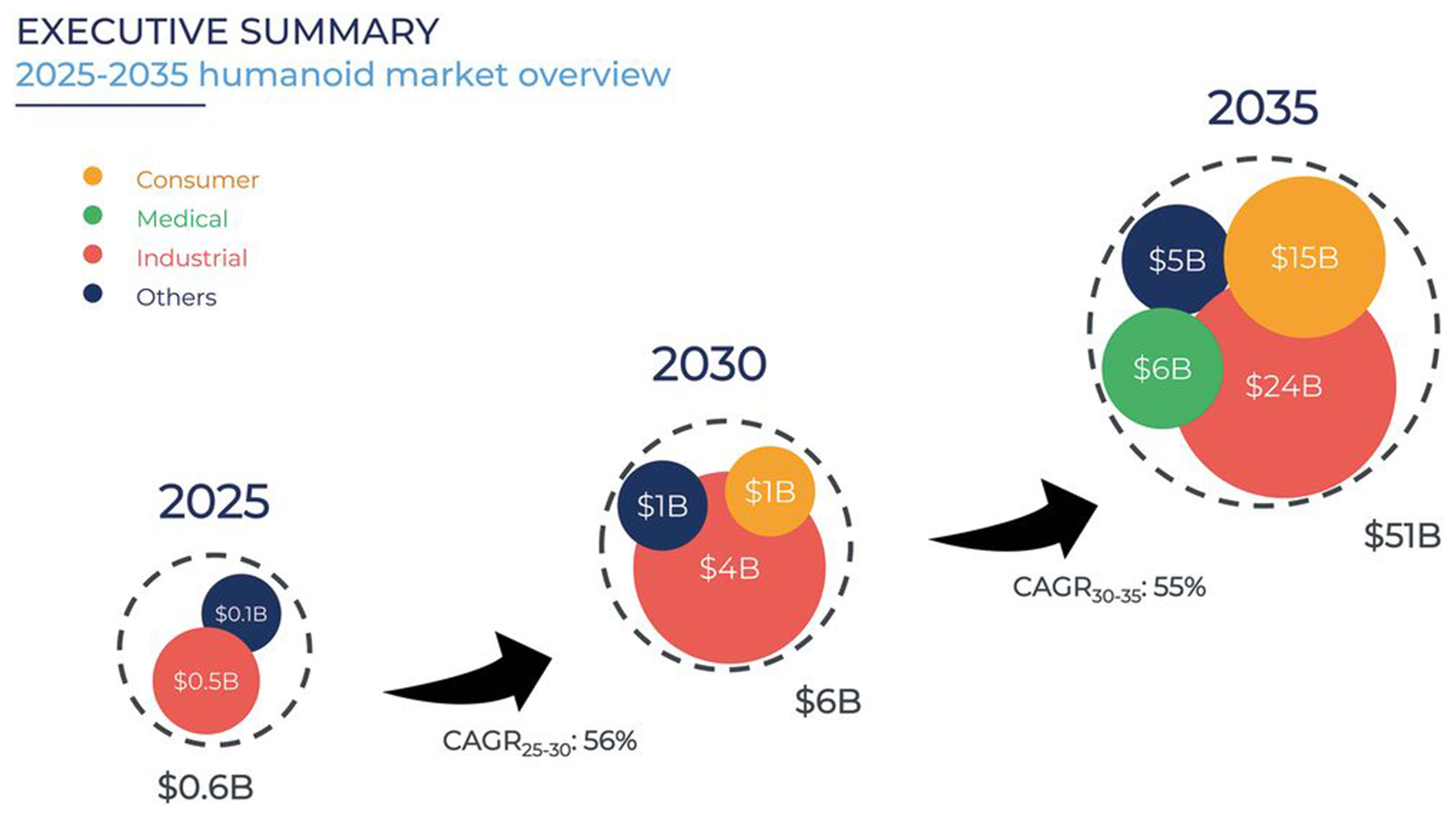
Although humanoid robots may currently be a niche product, they carry enormous revenue potential. When market researchers at the Yole Group investigated the actual size of this market, they estimated a revenue volume of $600 million for 2025. By 2030, they project a tenfold increase to approximately $6 billion an annual growth rate of 56 percent. In every sense, it is an exploding market.
Looking further ahead to 2035, market researchers at Yole project a revenue volume of $51 billion. Between 2030 and 2035, this would represent an annual growth rate of 55 percent a figure that remains substantial. In their current calculations, the researchers assume that humanoid robots are replaced every six years. Based on this, they estimate that approximately 8,000 robots entered the market in the previous year. Their forecast anticipates that 136,000 humanoid robots will enter the market annually by 2030, with that number reaching 2.1 million units by 2035.
Those who might expect the majority of the bill of materials (BOM) to consist of semiconductors such as power semiconductors would be mistaken. The market researchers point out that the BOM is dominated by mechanical components, dexterous hands, joint actuators, servomotors, and controllers. In contrast, they estimate that semiconductors account for only a small portion of the average selling price (ASP). For 2025, the researchers project that semiconductors will make up roughly 8 percent of the total. By 2035, they anticipate that due to economies of scale and higher levels of integration in processor units and silicon-based perception solutions this share of the BOM could decline to 5 percent.
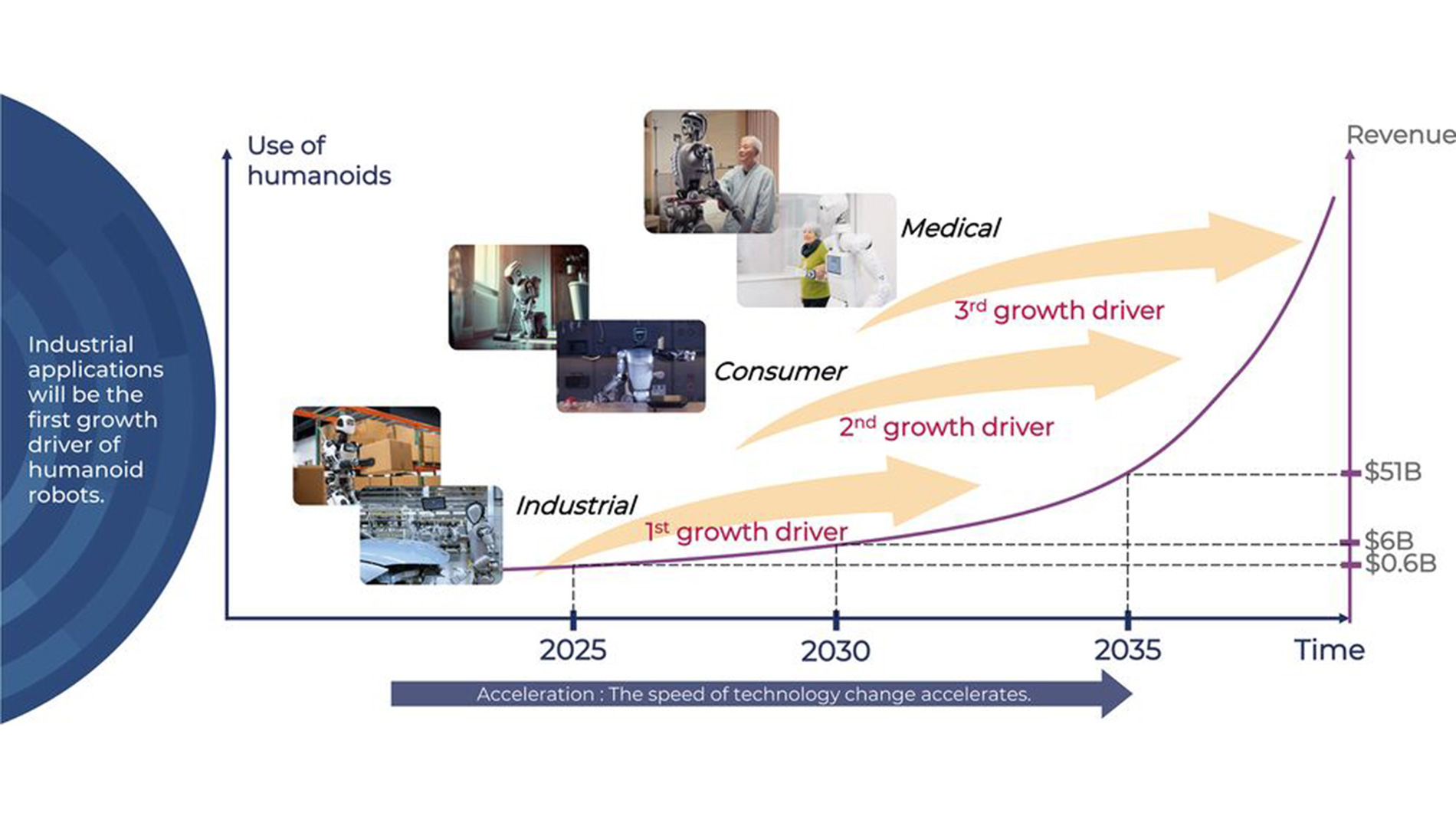
In their assessment of the future development of the market for humanoid robots, market researchers at Yole anticipate that their market entry will occur in three distinct waves. The first wave which is already underway focuses primarily on applications in intralogistics and support for light final assembly tasks within existing (brownfield) facilities and large warehouses. In these contexts, the return on investment is driven more by ergonomic relief and the filling of labor gaps than by a one-to-one replacement of human workstations. Examples include Apptronik’s “Apollo” robot, which handles the delivery of transport containers at Mercedes-Benz, and Agility’s “Digit,” which is used for handling bulk materials.
For the second wave, the market researchers expect that competition driven largely by Chinese OEMs will lead to the emergence of applications in the consumer sector. This includes humanoid robots such as the “R1” from Unitree, which reportedly has an average selling price of $5,600. Compared to their industrial counterparts, these “consumer” robots are characterized by more limited payload capacities, durability, and safety specifications.
Starting from a relatively modest revenue of $600 million generated primarily through industrial applications the market for humanoid robots is expected to grow tenfold to $6 billion by 2030. By 2035, analysts project a revenue volume of $51 billion. Industrial applications will continue to account for the largest share of this revenue, at $24 billion, followed by the consumer and medical sectors. (Image: Yole Group)
The third wave would involve the deployment of humanoid robots in the medical sector. To date, however, regulations and liability concerns have hindered their use at the bedside. Nevertheless, there are political signals such as the guidelines issued by the Chinese State Council aimed at integrating humanoid robots into elderly care. There are also indications of potential applications in rehabilitation, mobility assistance, and hospital ward logistics, which will serve as precursors to their eventual use in direct patient care.
Regarding the necessary investments, market researchers at Yole conclude that developers of humanoid robots should focus primarily on creating dexterous hands; this would not only make the robots appear more human-like but also expand their potential utility within industrial settings.
In this context, they note that dexterous hands currently account for approximately 31 percent of the average bill of materials (BOM) for a humanoid robot, while actuators account for 42 percent. The next challenge lies in reducing the costs of humanoid robots to a level that makes them attractive for consumer purchase. Ultimately, meeting safety standards and complying with regulatory requirements will be the final steps needed to trigger this third wave.
Over the coming years, humanoid robots will enter the market in three waves. The first wave already underway concerns the industrial sector. By 2030, consumer applications are expected to emerge. Market researchers anticipate that the use of these robots in care settings and directly at the bedside will not occur until the third wave, which is likely to begin in the next decade. (Image: Yole Group)
In their market research, analysts at Yole identified approximately 60 companies worldwide actively engaged in the development and manufacturing of humanoid robots. More than 50 percent of these firms are based in China, while 12 are located in the United States. In Europe, there are very few companies active in this sector; those identified by Yole analysts are primarily startups.
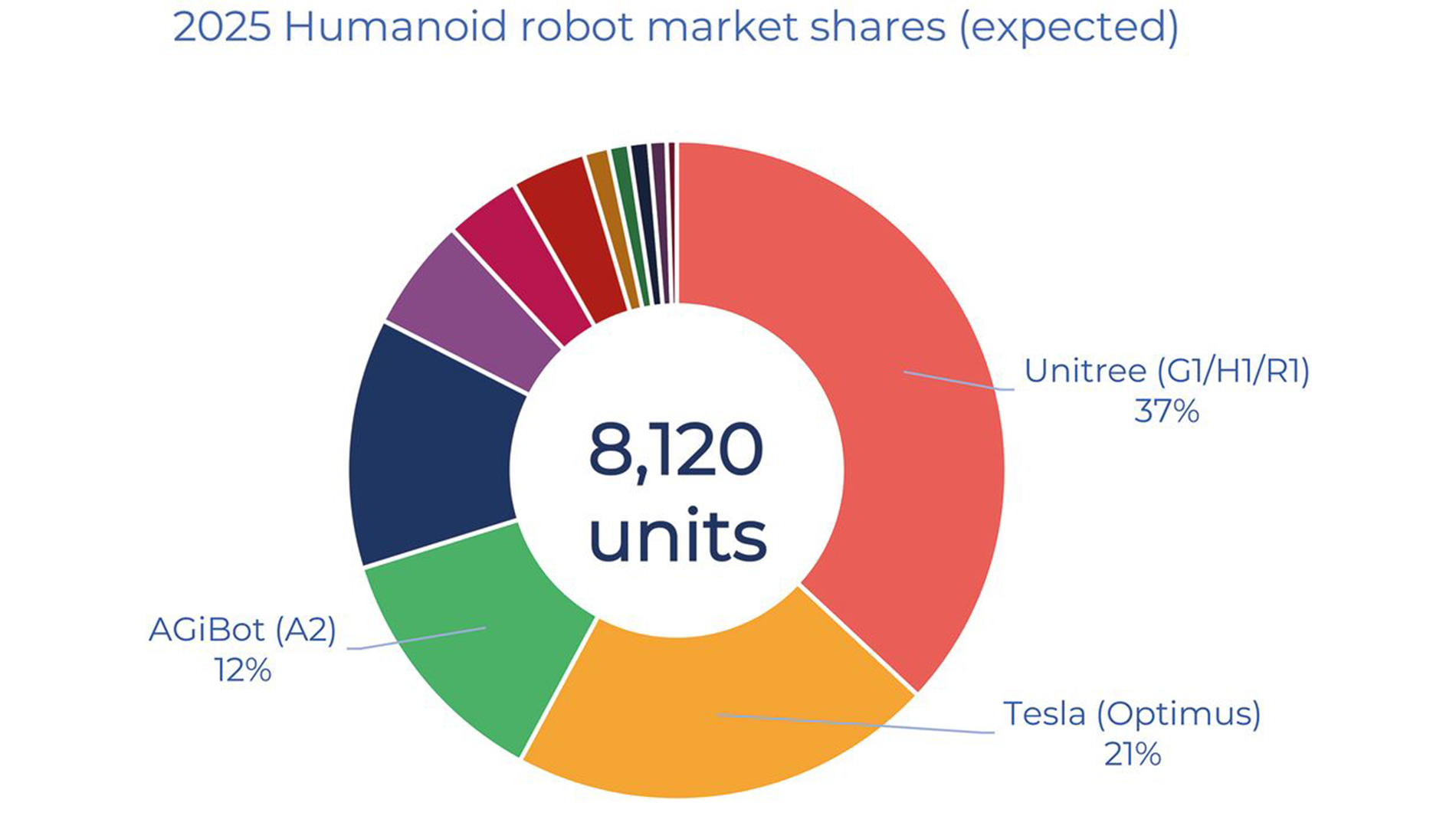
The market researchers conclude that, since 2017, roughly 10 billion dollars in financial investment has flowed into the development of humanoid robots globally with a significant portion concentrated in two companies: Ubtech and Figure AI. While both firms lead in terms of funding, they do not lead in terms of unit shipments. Regarding sales figures for 2025, Yole projects that 37 percent of all humanoid robots delivered will come from Unitree, followed by Tesla with a 21 percent market share, and AgiBot with 12 percent. Specifically, the Yole Group analysts estimate that four companies Unitree, Tesla, AgiBot, and Ubtech currently dominate approximately 82 percent of the humanoid robot market.
In this initial wave, on the demand side, leading humanoid robot manufacturers are forming partnerships with major corporations such as automotive and logistics companies to launch pilot programs. Such initiatives are being pursued by companies including Apptronik, Figure AI, Agility, Astribot, and Ubtech. Beyond industrial applications, Unitree has established itself as a strong provider within the sectors of research and development (R&D), education, and integration for early-stage adopters.
In its initial phase in 2025, with a sales volume of approximately 600 million dollars, the market for humanoid robots was essentially divided among four companies: Unitree, Tesla, AgiBot, and Ubtech. These four firms accounted for roughly 82 percent of the total market. (Image: Yole Group)
Regarding the ecosystem necessary for the development of humanoid robots, Yole market researchers point to a plan implemented by China’s Ministry of Industry and Information Technology (MIIT) between 2023 and 2025, which aimed to establish a comprehensive innovation environment for “HumanID” and secure the essential core components. While Nvidia remains the leader in the computing sector, Yole analysts note that local firms such as Horizon Robotics and Cambricon are gaining traction by following similar trends seen in automotive computing. For other critical components, including sensors, actuators, batteries, and encoders, the Chinese ecosystem is already sufficiently well-positioned to supply these parts in large volumes.
Given that companies like Fourier Intelligence and Agility Robotics currently sell humanoid robots for industrial use at prices reaching $100,000 or more, Yole market researchers anticipate that the average purchase price will drop from approximately $75,000 in 2025 to around $25,000 by 2035. Their forecast suggests that, regardless of whether a unit is a simple, basic, or top-tier model, the retail price in 2035 will likely fall within the $20,000 to $30,000 range.
An indicator for this forecast might be the price of the entry-level R1 robot unveiled by Unitree in July 2025 which has an average selling price of $6,000. Other companies, such as Apptronik, are taking a different approach: they aim to sell their humanoid robots at the price of a new car, according to Apptronik co-founder and CEO Jeff Cardenas. eg